
 English
 中文

-

What are the battery certifications? What are the standards for battery certification
-
Leading Global Compliance: In-depth Dissection of the New IS/IEC 62368-1:2023 Electronic Safety Standard
-
2026 India BIS Update Barometer: Countdown to Mandatory Version Replacement for XR and Electronic Products
-
2026 Latest Guide: What Certification Materials are needed for Battery exports to the United States?
-
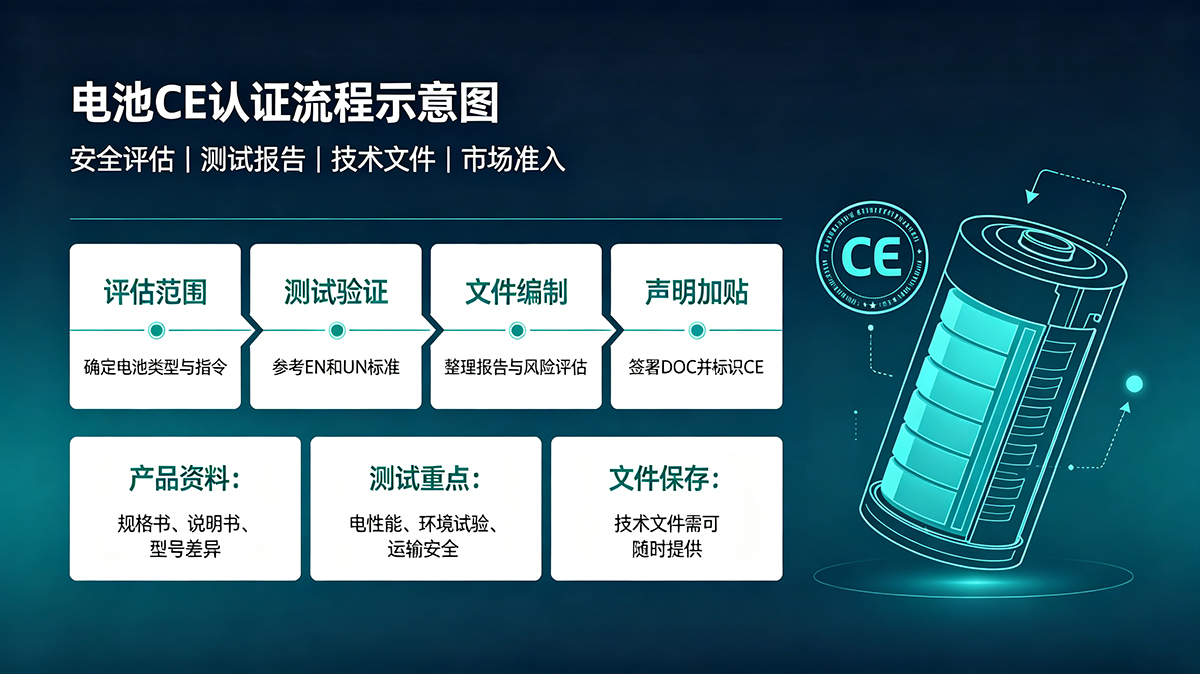
How to obtain the EU CE certification? Compliance Guide for Battery Exports to Europe
What certifications are required for battery exports to Europe? Key Points Analysis of CE Certification
The export of batteries to Europe requires not only production capacity but also compliance with the regulatory requirements of the target market. As an important compliance step in the European market, the EU CE certification requires enterprises to plan in combination with product types, safety standards and regulatory requirements.
How to obtain the EU CE certification? Compliance Guide for Battery Exports to Europe
For battery enterprises, entering the European market requires not only focusing on product performance but also attaching great importance to regulatory compliance. The EU CE certification is not only a testing requirement but also an important way for enterprises to establish a product safety system. Understanding the battery CE certification process in advance, clarifying the testing standards and improving the technical data can help enterprises reduce export risks and enhance the stability of their products entering the European market.
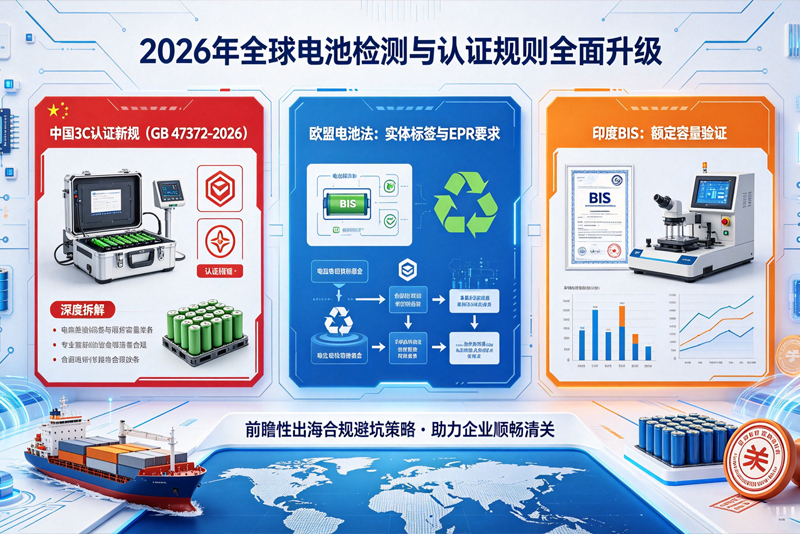
A Comprehensive Analysis of the New Battery Testing and Certification Regulations: Advanced Guidelines for Battery Customs Clearance and Compliance in Various Countries in 2026
With the continuous upgrading of global green and low-carbon transformation and consumer electronics safety regulation, the testing and certification standards of the battery industry have undergone an all-round iteration in 2026. From the update of the new national standards for domestic mobile power banks and the 3C certification rules, to the implementation of the entity labels under the new EU battery Law, and then to the tightening of testing requirements in emerging markets, major economies around the world are reshaping the battery supply chain with stricter "compliance access vouchers". This article provides you with an in-depth analysis of the new trends in global battery customs clearance and compliance in 2026, helping you make precise plans and break through to go global.
A Guide to Avoiding Pitfalls in Lithium Battery Export Certification: Common Problems, Failure Causes and Countermeasures
 Click:251编辑: 诚测检测CCJC-电池认证机构
 Time:2026-10-10 15:20:33
Many lithium battery enterprises have had similar experiences: samples sent for testing have no results for a long time, or the certificates have just been obtained, but the customers ask for additional reports. The export certification of lithium batteries involves product standards, label information, technical documents and transportation data. Any lack of preparation in any of these aspects may affect the progress of testing or the efficiency of customs clearance. For enterprises, identifying high-frequency problems in advance is more important than conducting supplementary tests afterwards.
Many enterprises understand certification as "sending for inspection and obtaining the certificate", but in reality, the process is more like a compliance check-up. Whether the product structure is clear, whether the parameters are consistent, whether the data is complete, and whether the target market is accurately judged will all affect the certification cycle.
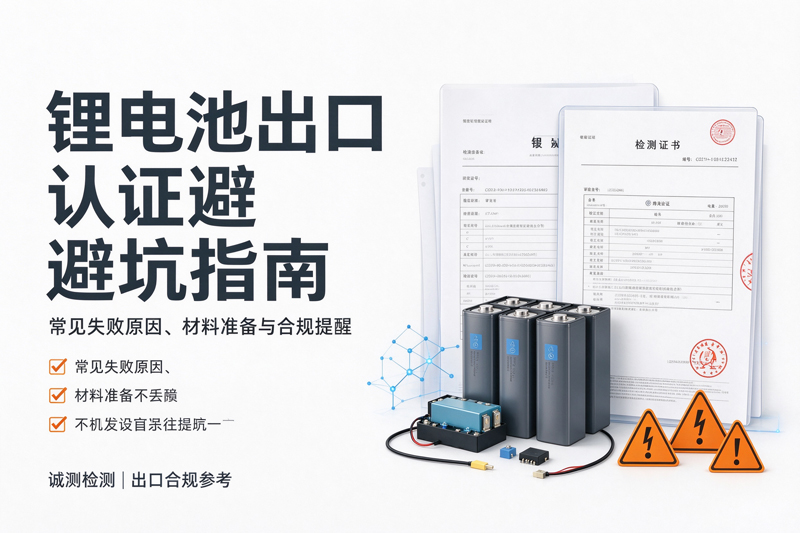
What are the common problems in the export certification of lithium batteries?
Question 1: Unclear determination of product range. There are many forms of lithium battery products, and the applicable standards for battery cells, battery packs, energy storage batteries, and power batteries are not the same. If an enterprise makes a wrong classification in the early stage, the subsequent inspection items will also deviate. For instance, battery packs with protection boards and individual cells have different evaluation focuses. Batteries used in energy storage devices and those used in consumer electronics may also require different combinations of standards.
Question 2: The standard version is not updated in a timely manner. Battery-related standards in different countries are updated along with technological and regulatory changes. If enterprises still prepare materials according to the old standards, there may be situations where the test results are not recognized or the validity of the certificates is insufficient. Therefore, confirming the standard version before applying is more crucial than directly asking "Can it be done?"
Question 3: Incomplete technical documentation. Lithium battery certification typically requires documentation such as specification sheets, circuit diagrams, Boms, instruction manuals, label diagrams, and product photos. Missing data will lead to supplementary samples, additional materials and an extended cycle. Some enterprises believe that "as long as the sample is fine, it's fine", but testing institutions not only look at the performance of the sample, but also check whether the data is consistent with the sample.
Question 4: Labels and instructions are non-compliant. Labels are a part that many enterprises tend to overlook. When lithium batteries enter different markets, factors such as names, parameters, warning statements, manufacturer information, and recycling information may all affect compliance judgments. The instruction manual is equally important. If the parameters in the manual do not match those in the sample, it may raise questions during the review.
Question 5: Confusion between transportation documents and sales certifications. Some enterprises think they can directly ship goods after obtaining CE or FCC reports. In fact, UN 38.3 or the corresponding transportation appraisal materials may also be required in the transportation process. Therefore, enterprises should prepare "market access certification" and "transportation safety data" separately.
Ii. Frequent Reasons for the failure of Lithium Battery export certification
According to the feedback from enterprises for inspection and exports, the following types of problems occur frequently.
Inconsistency between the sample and the data: The parameters on the sample nameplate, in the manual, and in the specification sheet are inconsistent, which is a common problem in the certification process. For instance, if the capacity, voltage and model marked on the sample do not match the information provided, it will directly affect the review result.
2. Inadequate protection functions: The overcharge, overdischarge, overcurrent, short circuit, and thermal abuse protection functions of lithium batteries are key assessment items in many standards. If the protection circuit design is unstable or the sample shows abnormalities during the test, it may be necessary to rectify and retest.
3. Electromagnetic compatibility issues: Battery products with electronic control, display, communication or wireless functions may involve electromagnetic compatibility assessment. Some enterprises only focus on battery safety and neglect EMC testing, which leads to obstacles when their products enter markets such as the United States and the European Union.
4. Incorrect standard selection: The selection of standards should not be as comprehensive as possible, but rather should be in line with the product category and the target market. If enterprises apply the standards of other products, there may be duplicate testing items or omissions of key items.
5. Customer requirements overlap with local regulatory requirements. A customer's request for a certain certification does not mean that the enterprise only needs to meet the customer's requirements. Local market supervision, customs clearance and random inspection may still have independent requirements. Enterprises should combine customer requirements with local access requirements for judgment.
Iii. How can enterprises reduce the risk of Certification failure?
First, conduct a pre-assessment of the product. Before the official submission for inspection, the enterprise should confirm the product category, electrical parameters, application scenarios and target markets. Pre-assessment can help enterprises narrow down the scope of testing and reduce unnecessary tests.
Second, establish a list of materials. It is recommended that enterprises prepare in advance the product specification sheet, assembly drawing, circuit diagram, BOM, label diagram, manual, list of key components and other materials. The more complete the materials are, the smoother the review will be.
Third, ensure consistency between samples and data. Enterprises should guarantee that the sample model, nameplate parameters, manual parameters and test data are consistent. Especially for key information such as capacity, voltage, power and protection functions, there must be no contradictions.
Fourth, pay attention to the standard version and the scope of the certificate. After obtaining the certificate, the enterprise should also confirm the product model covered by the certificate, the standard version, the validity period and the applicable market. Some certificates only cover specific models. If design changes occur during subsequent mass production by enterprises, re-evaluation may be necessary.
Fifth, plan the sales certification and transportation documents simultaneously. Lithium battery exports usually require more than one set of documents. Enterprises should simultaneously consider market certification, label compliance, instruction manual compliance and transportation data to avoid last-minute replacement of documents just before shipment.
Iv. Real Case: Certification Adjustment of a Certain Energy Storage Battery Enterprise
A company that produces household energy storage batteries initially only prepared some test materials in accordance with a single EU requirement. Later, the client added the markets of the United States and South Korea, and the enterprise had to temporarily make up for the FCC and KC-related evaluations, which led to an extension of the project cycle. After reorganizing, the enterprise classified its products by cell, battery pack and BMS functions respectively, first confirmed the list of target markets, and then arranged the testing sequence. In subsequent projects, the enterprise reduced repetitive testing and also lowered the waiting time for customers.
This case demonstrates that the export certification of lithium batteries is not merely a matter of "supplementing the report", but requires prior planning. The clearer the product structure and the more definite the market target, the more controllable the certification path will be.
The export certification of lithium batteries involves multiple links such as standards, documents, labels and transportation. Enterprises should not only focus on the speed of obtaining the certificate. Identifying common problems in advance, conducting pre-assessment of products and preparing relevant materials can reduce the risks of material replenishment, retesting and customs clearance. For enterprises that frequently interact with overseas clients, the global certification capability of lithium batteries has become a part of their supply chain capabilities. Chengce Testing suggests that enterprises conduct compliance confirmation during the product development and order-taking stages to avoid certification issues affecting the delivery rhythm.
相关BlOG
-
What certifications are required for battery exports to Europe? Key Points Analysis of CE Certification
The export of batteries to Europe requires not only production capacity but also compliance with the regulatory requirements of the target market. As an important compliance step in the European market, the EU CE certification requires enterprises to plan in combination with product types, safety standards and regulatory requirements.
13162026-07-10
-
How to obtain the EU CE certification? Compliance Guide for Battery Exports to Europe
For battery enterprises, entering the European market requires not only focusing on product performance but also attaching great importance to regulatory compliance. The EU CE certification is not only a testing requirement but also an important way for enterprises to establish a product safety system. Understanding the battery CE certification process in advance, clarifying the testing standards and improving the technical data can help enterprises reduce export risks and enhance the stability of their products entering the European market.
12272026-07-06
-
A Comprehensive Analysis of the New Battery Testing and Certification Regulations: Advanced Guidelines for Battery Customs Clearance and Compliance in Various Countries in 2026
With the continuous upgrading of global green and low-carbon transformation and consumer electronics safety regulation, the testing and certification standards of the battery industry have undergone an all-round iteration in 2026. From the update of the new national standards for domestic mobile power banks and the 3C certification rules, to the implementation of the entity labels under the new EU battery Law, and then to the tightening of testing requirements in emerging markets, major economies around the world are reshaping the battery supply chain with stricter "compliance access vouchers". This article provides you with an in-depth analysis of the new trends in global battery customs clearance and compliance in 2026, helping you make precise plans and break through to go global.
12072026-07-23